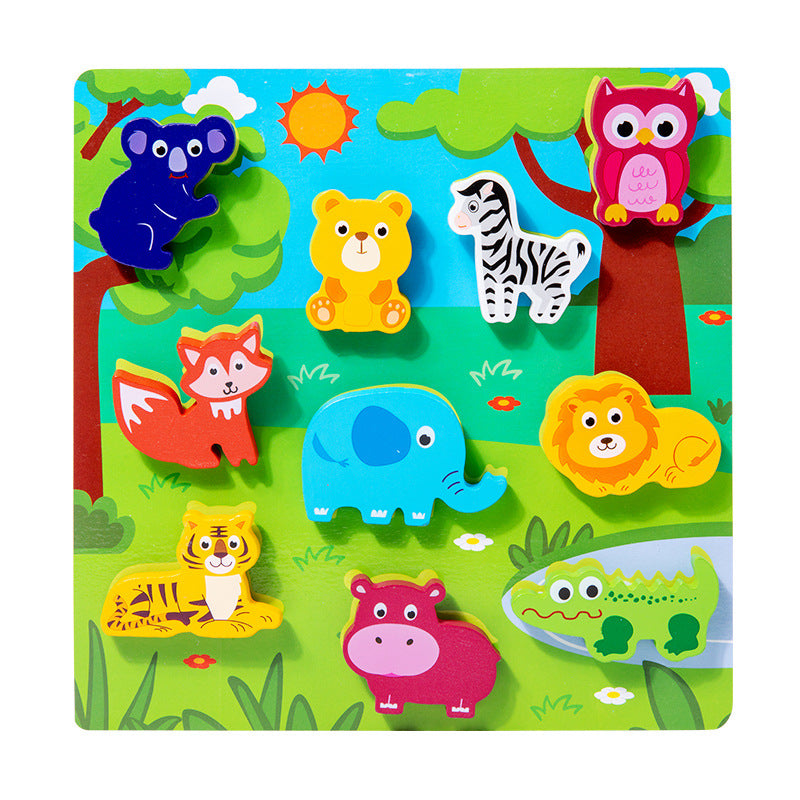
Kinmilo 3D Hook-and-Loop Matching Puzzle Boards – 8 Animal, Fruit & Vehicle Themes
Kinmilo 3D Hook-and-Loop Matching Puzzle Boards – 8 Animal, Fruit & Vehicle Themes
Lift, Match, Name & Explore — Hands-On Picture Play Together
One bright picture board opens the door to dozens of shared learning moments. Kinmilo 3D Hook-and-Loop Matching Boards feature raised illustrated pieces that children lift, recognize, position and fasten back onto the matching scene. A reusable hook-and-loop attachment makes the same familiar activity enjoyable again and again. Choose a theme that matches your child’s interests and turn a simple match into a conversation, a movement activity or a playful story.
Kinmilo Together Time: A Parent–Child Play Plan
Play Together. Grow Together. Use your 3D Hook-and-Loop Matching Puzzle Boards as a starting point for relaxed, child-led interaction. Try one short activity, and follow your child's interests, developmental stage and comfort.
- 1. Connect & demonstrate: Choose one vehicle or train piece and demonstrate a simple journey across the table or floor.
- 2. Share the play: Take turns moving vehicles, stopping at a pretend station and requesting “go” or “stop”.
- 3. Grow together: Build a short route, count stops or introduce a safety sign that the child chooses.
Adapt play for ADHD, autism and different learning needs
For attention differences, use one route and one vehicle; for language differences, offer gesture or picture choices. Watch any detachable wheels or small pieces.
Caregiver tip: Children can respond through speech, gestures, pointing, eye gaze or AAC. Support their choices, avoid forcing performance, and celebrate moments of shared play. These are opportunities for learning and connection, not treatment for ADHD, autism or learning disabilities and not a guarantee of a particular outcome. Follow the product-specific age and safety guidance.
Choose Your Theme
- Construction Vehicles: excavators, trucks and building-site vocabulary.
- Dinosaurs: colorful prehistoric creatures for sorting and storytelling.
- Insects: bees, butterflies, ladybirds and other garden friends.
- Fruit Garden: identify fruits, colors and pretend shopping choices.
- Woodland Animals: match familiar animals in a forest scene.
- Road & Rescue Vehicles: cars, buses, emergency and transport vehicles.
- Ocean Animals: fish, whales, sea turtles and underwater discoveries.
- Farm Animals: familiar farm friends and simple everyday stories.
Practical Parent & Caregiver Play Guide
- Start with just two pieces: place the chosen board on a stable table. Offer two raised pieces and ask, “Can you find where the butterfly goes?” Point to the picture and demonstrate once.
- Offer a choice, not a test: hold up two pieces, name them clearly and invite a child to choose with a word, gesture, eye gaze or AAC device. A response can be placing, looking at or pointing to the picture.
- Build fine-motor opportunities: let the child grasp, lift, rotate, align, press and peel the figures. Use hand-over-hand help only when welcomed; otherwise model the movement and give time to try.
- Practice turn-taking: take turns choosing one piece, using “my turn / your turn” language or picture symbols. Celebrate engagement rather than speed or perfect accuracy.
- Extend into pretend play: the bus goes to school, the turtle swims past a whale, or the fruit is packed for a picnic. Ask an open-ended question and accept many kinds of responses.
- Make a comfortable ending: finish after a small number of matches, put the pieces back together and use a familiar “all done” cue. Revisit the same theme over several short sessions.
Inclusive Learning & Adaptation
For children with ADHD or high activity levels, use short rounds, allow a standing position and alternate matching with movement. For autistic children, establish a predictable order and let the child choose a preferred theme. For children with developmental delays, intellectual disabilities or complex communication needs, begin with one highly visible match and use simple single-step prompts, visual choices, gestures and AAC. For children with different hand-control or sensory preferences, offer larger movements, quieter spaces and relaxed pacing. These are engaging practice opportunities in shared attention, choice-making, visual matching, everyday vocabulary and hand coordination; the toy is not a medical treatment.
Design & Care
Brightly printed picture scenes, lightweight raised illustrated pieces and reusable hook-and-loop fastening. Choose one of the eight pictured themes using the Theme selector. Keep matching pieces together, wipe surfaces gently and allow them to dry before storage. Adult supervision is recommended, particularly when a child mouths objects.
Safety & Test Documentation
Kinmilo products have CPC and CE test reports. Safety documents relate to the product tested; follow the age and safety guidance shown with the product.
Frequently Asked Questions
Is this toy compatible with Montessori or Waldorf play?
Its self-directed picture matching, hands-on repetition and imaginative storytelling support Montessori-inspired practical exploration and Waldorf-inspired creative play.
How can I use it with a child who does not speak?
Offer two visual choices, model the names, and invite pointing, eye gaze, gesture, signs or AAC communication instead of requiring speech.
What if my child finds the activity difficult?
Start with one matching piece, clearly demonstrate the placement, and gradually introduce a second piece when the child shows interest.
Can I use several themes together?
Each theme is selected as its own product variant; a family can build a broader collection of matching activities as interests grow.
Couldn't load pickup availability