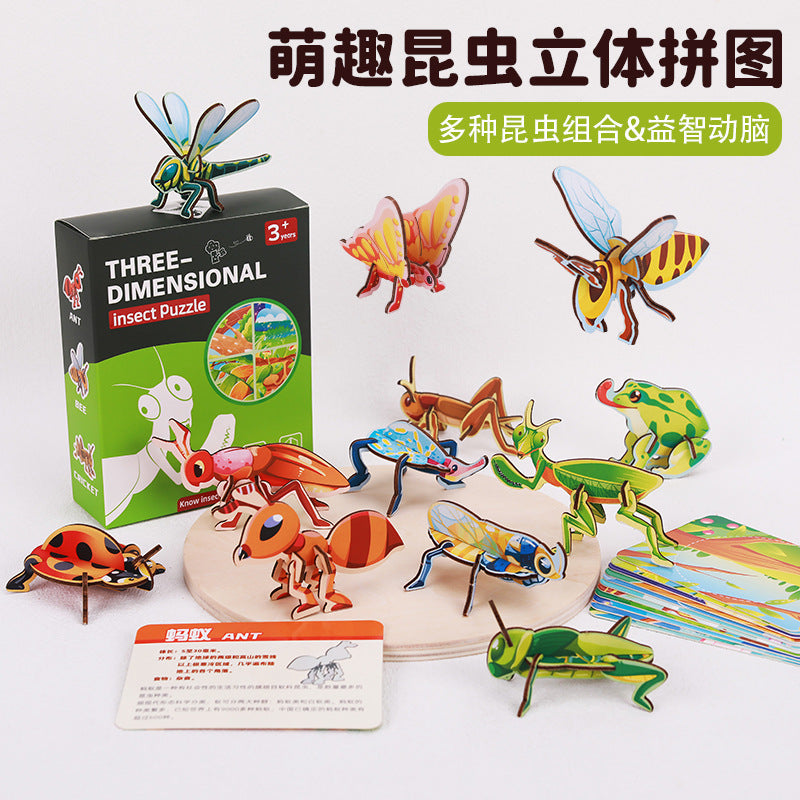
Kinmilo 3D Insect Assembly Puzzle – Nature Habitat & Fine Motor Play
Kinmilo 3D Insect Assembly Puzzle – Nature Habitat & Fine Motor Play
Build a Tiny World of Insects — 3D Nature Play Through Discovery
Turn illustrated insect characters into a hands-on nature adventure. The Kinmilo 3D Insect Assembly Puzzle features colorful three-dimensional insect figures alongside nature-inspired illustrated scenes. Children explore the shapes, wings, legs and colors of familiar insects while adults model the assembly process and invite imagination. The product imagery includes butterfly, dragonfly, grasshopper, beetle, bee and ladybird-inspired insect designs.
Kinmilo Together Time: A Parent–Child Play Plan
Play Together. Grow Together. Use your 3D Insect Assembly Puzzle as a starting point for relaxed, child-led interaction. Try one short activity, and follow your child's interests, developmental stage and comfort.
- 1. Connect & demonstrate: Choose a favourite animal or nature picture and show one simple matching or feeding action.
- 2. Share the play: Take turns placing pieces while naming a colour, body part, habitat or food; accept any communication method.
- 3. Grow together: Make a short animal story, or let the child decide which picture comes next.
Adapt play for ADHD, autism and different learning needs
For visual-processing needs, show one animal and two choices. Keep interaction predictable and supervise all detachable pieces.
Caregiver tip: Children can respond through speech, gestures, pointing, eye gaze or AAC. Support their choices, avoid forcing performance, and celebrate moments of shared play. These are opportunities for learning and connection, not treatment for ADHD, autism or learning disabilities and not a guarantee of a particular outcome. Follow the product-specific age and safety guidance.
What Makes This Activity Special?
- Standing 3D insect structures add a tactile construction dimension to familiar nature pictures.
- Printed habitat scenes provide storytelling prompts and make a miniature bug world for pretend play.
- Different insect silhouettes provide opportunities to compare wings, body shapes and colors.
- The build-and-play format encourages shared observation, following a sequence and careful hand movements.
Five Guided Activities for Parents & Caregivers
- Explore first: show one insect model, name its colors and notice its body parts. Invite the child to point to the wings or copy a gentle fluttering movement.
- Build alongside your child: demonstrate how the model's pieces connect, offer one step at a time and give the child opportunities to place or align pieces.
- Match the habitat: place the insect on a matching nature illustration and describe where it lives or what it might be doing.
- Take turns telling a story: move one insect at a time through a garden scene. Use “your bug / my bug” language or two pictures for making choices.
- Compare and sort: ask which insects have big wings, which are red or which can hop. Make two small groups and invite the child to choose the next figure.
Adapt Play to the Child, Not the Other Way Around
For a child with ADHD or high activity levels, alternate a short construction step with a movement break such as “fly like a butterfly.” For autistic children, show the finished example, preserve a consistent build sequence and use favorite insects to support interest. For children with developmental delay, intellectual disabilities or more complex communication needs, reduce the task to one piece at a time, model the answer and welcome non-verbal responses using pointing, gestures or AAC. For motor challenges, stabilize the picture card while the child places pieces, and pause whenever fatigue or frustration appears. These routines create opportunities to explore fine-motor actions, early science vocabulary, sequencing and cooperative play, without promising clinical or developmental outcomes.
Materials, Learning Approach & Care
Full-color illustrated cards with lightweight press-fit three-dimensional insect construction pieces as shown in the photographs. Keep the model parts with their illustration cards, assemble on a flat surface and store flat or carefully after play. Adult supervision is important when using small assembly pieces.
Safety & Test Documentation
Kinmilo products have CPC and CE test reports. Follow the product age guidance and use under appropriate adult supervision.
FAQ
Does this work for Montessori or Waldorf-inspired learning?
Yes. Observation, hands-on assembly, child-led exploration and imaginative storytelling make this a useful Montessori- and Waldorf-inspired activity.
Can non-speaking children join in?
Yes. Offer two insect pictures to choose between and invite eye gaze, gesture, pointing or AAC responses.
What if assembling is hard?
Build one section together, then invite the child to place a single accessible part or use the finished models for matching and storytelling.
Can children play together?
Yes. One child can choose an insect or habitat while another builds or tells part of the story; adults can scaffold gentle turn-taking.
Couldn't load pickup availability