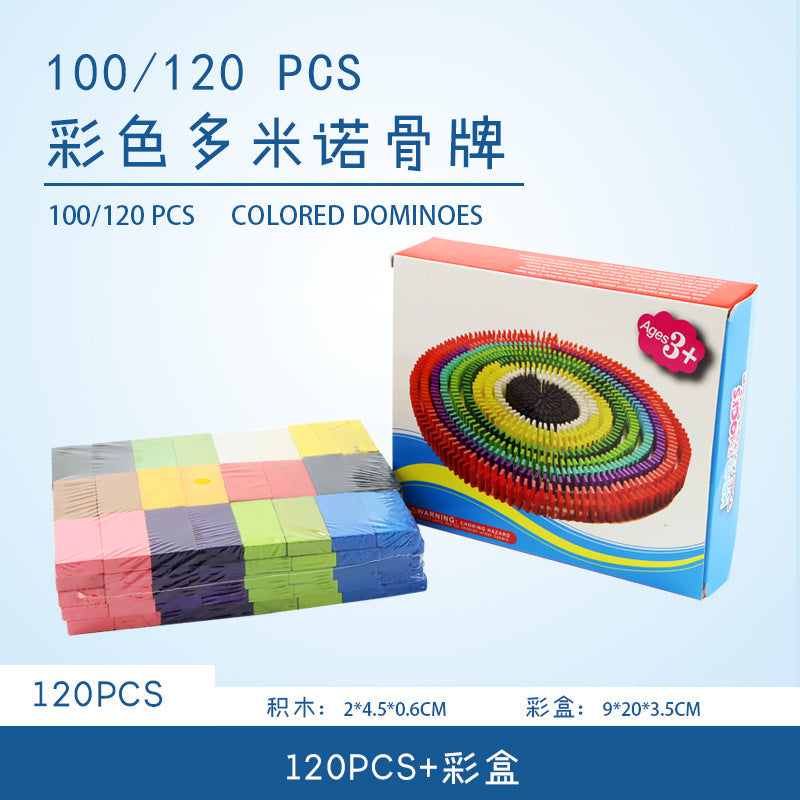
Kinmilo Colored Wooden Dominoes & Construction Planks – 100 to 300-Piece Building Sets
Kinmilo Colored Wooden Dominoes & Construction Planks – 100 to 300-Piece Building Sets
One Set, Endless Building and Pattern Possibilities
Kinmilo creates hands-on learning invitations for family play, preschool activities and caregiver-led practice. Every turn is a chance to look, touch, talk, compare and celebrate a small success.
Kinmilo Together Time: A Parent–Child Play Plan
Play Together. Grow Together. Turn Colored Wooden Dominoes & Construction Planks into relaxed parent–child interaction. Begin with a short activity, respond to your child's interests and allow breaks.
- 1. Connect & demonstrate: Choose two sturdy pieces and demonstrate stacking or positioning one.
- 2. Share the play: Take turns adding pieces to a small shared construction.
- 3. Grow together: Build a colour sequence or let the child make a model for you.
Adapt the activity for ADHD, autism and developmental or learning differences
Use a stable base, larger pieces and three-piece tasks when helpful. For children with different communication needs, invite speech, pointing, gesture, eye gaze or AAC. A predictable start, limited choices and a clear stopping point can make play easier to join.
A note for families: Enjoy connection and meaningful participation rather than speed or perfect answers. These activities offer educational practice opportunities, not a medical treatment or a guaranteed developmental outcome. Follow the product's age and safety instructions, especially for detachable components.
Materials, Contents & Dimensions
Choice of coloured wooden domino blocks and natural or multicolour narrow construction planks, in 100–300-piece set configurations. Verified coloured domino tile dimensions: 2 × 4.5 × 0.6 cm per tile. The illustrated 100-piece coloured set shows a box measuring 13.5 × 16.5 × 3.5 cm. Construction plank pack sizes vary by set, with individual architectural builds pictured in the gallery. Wood is the principal material.
How Parents & Caregivers Can Play
- Start by lining up five blocks and count them aloud as your child touches each one.
- Create a short domino trail and let the child gently start the falling chain. Watch and describe the sequence.
- Build a bridge, little house, tower or roadway with a parent demonstrating one layer at a time.
- Ask the child to copy a simple colour sequence such as blue-yellow-blue-yellow.
- Offer the child a design choice, then take turns adding a single plank to a shared building.
Inclusive Activity Ideas
For children with ASD, ADHD or developmental delays, use one clear model instead of an overwhelming pile, add movement breaks and give a predictable start-and-finish routine. Placing individual dominoes offers graded fine-motor practice; matching colours, counting and recreating patterns give flexible activity goals.
Start with short, enjoyable turns. Model the action, offer a choice between two pieces, allow processing time and adjust the challenge to the child's preferences. Encourage participation rather than speed or perfection. Activities provide opportunities to practise communication, attention, visual discrimination, sensory exploration and fine-motor coordination; they are not medical treatment.
Care & Product Testing
Wipe wooden components with a lightly damp cloth and dry promptly. Use with age-appropriate supervision, especially around smaller pieces. CPC and CE testing reports are part of Kinmilo's product documentation.
Frequently Asked Questions
- Is this toy compatible with Montessori or Waldorf-inspired play?
- Yes. Its tactile, open-ended activities support Montessori-style independent discovery and Waldorf-inspired imaginative, hands-on play.
- Can children with ASD, ADHD or developmental delays enjoy it?
- Yes. Caregivers can simplify the choices, model each step and build predictable turn-taking routines suited to the individual learner.
- How can I encourage a child who needs extra support?
- Reduce the number of pieces on the table and demonstrate one domino or plank placement before inviting a turn.
- Is this a therapy or medical device?
- No. It is an educational play resource for guided, everyday learning activities.
Couldn't load pickup availability