Kinmilo Colorful Spatial Logic Pattern Sticks & Challenge Cards | 2 Editions
Kinmilo Colorful Spatial Logic Pattern Sticks & Challenge Cards | 2 Editions
Build a Pattern. Share a Discovery.
Turn colorful sticks and visual challenge cards into a hands-on world of shapes, spatial relationships and shared discoveries. The Kinmilo Colorful Spatial Logic Pattern Sticks invite children to copy a pictured design, place each colored stick in the right position, rotate pieces and invent entirely new patterns. A calm, screen-free tabletop activity for parents, caregivers, preschool classrooms and learning-support environments.
Kinmilo Together Time: A Parent–Child Play Plan
Play Together. Grow Together. Turn Colorful Spatial Logic Pattern Sticks & Challenge Cards into relaxed parent–child interaction. Begin with a short activity, respond to your child's interests and allow breaks.
- 1. Connect & demonstrate: Choose one clear shape and demonstrate positioning the first piece.
- 2. Share the play: Take turns fitting pieces into a small pattern or space.
- 3. Grow together: Invite the child to invent a design for you to copy.
Adapt the activity for ADHD, autism and developmental or learning differences
Use two pieces and a finished visual model to reduce complexity. For children with different communication needs, invite speech, pointing, gesture, eye gaze or AAC. A predictable start, limited choices and a clear stopping point can make play easier to join.
A note for families: Enjoy connection and meaningful participation rather than speed or perfect answers. These activities offer educational practice opportunities, not a medical treatment or a guaranteed developmental outcome. Follow the product's age and safety instructions, especially for detachable components.
Choose Your Activity Edition
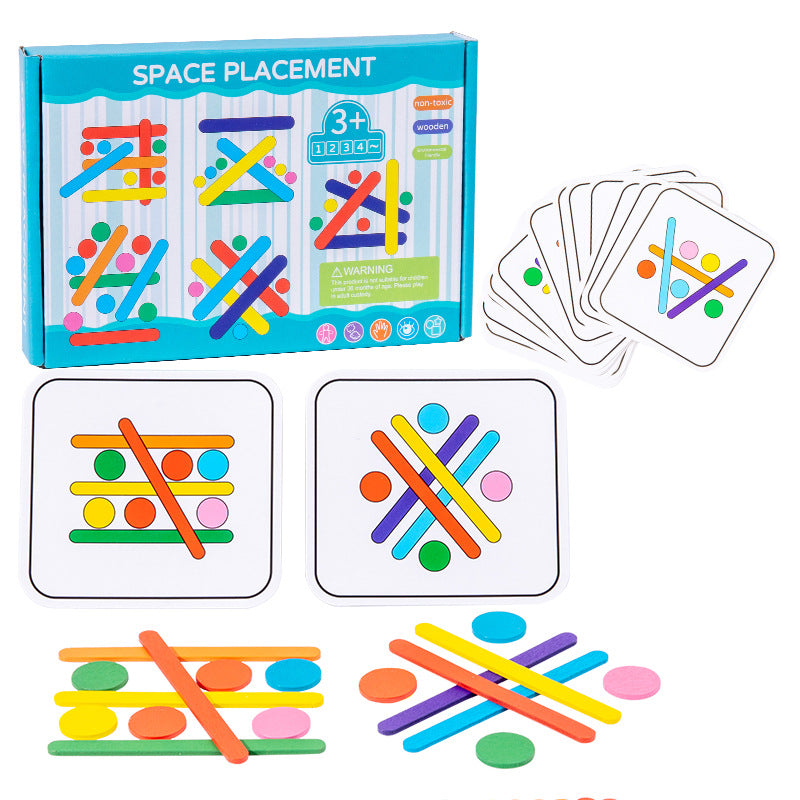
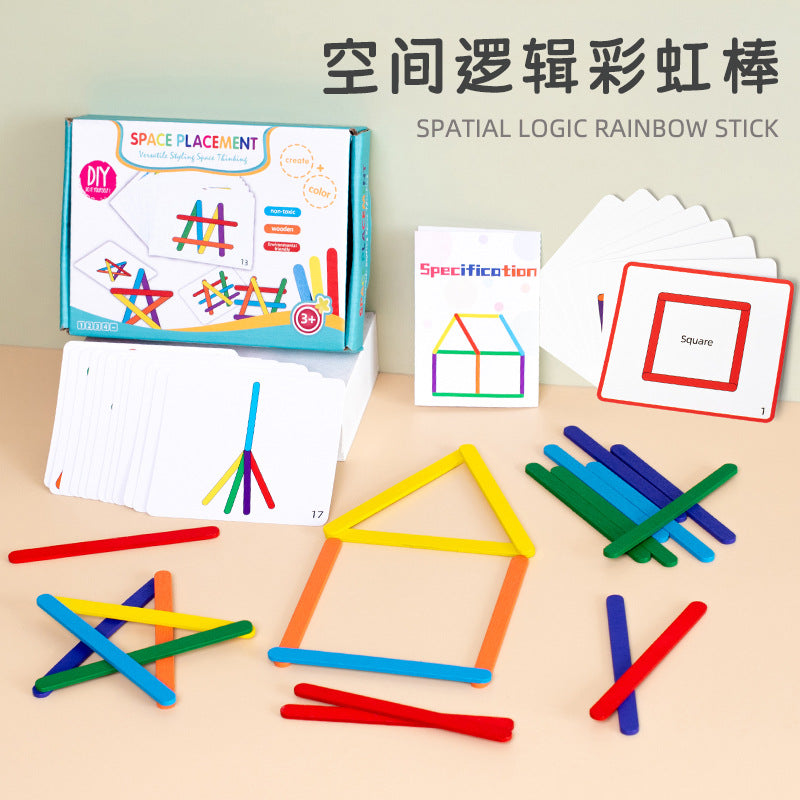
- Edition A – Space Placement & Color-Dot Logic: bright visual placement tasks with illustrated picture prompts, colorful sticks and rounded color elements as pictured. Best for side-by-side observation, comparing directions and building layered arrangements.
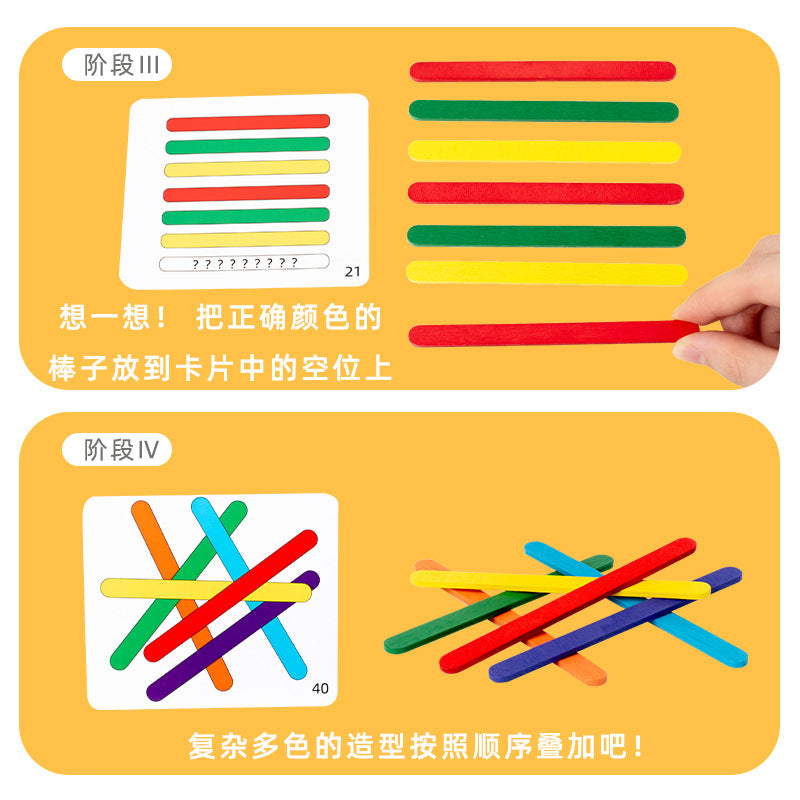
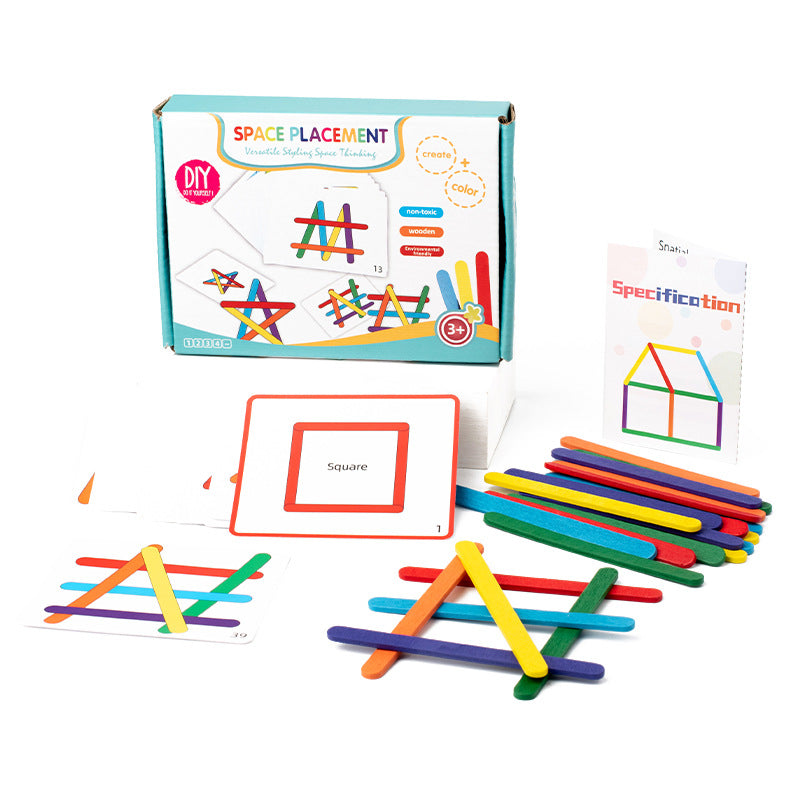
- Edition B – Classic Rainbow Pattern Sticks: 30 colorful sticks and 20 illustrated challenge cards shown in the product images. Children construct outlined figures, lines, stars, triangles and imaginative house-like shapes from the sample cards.
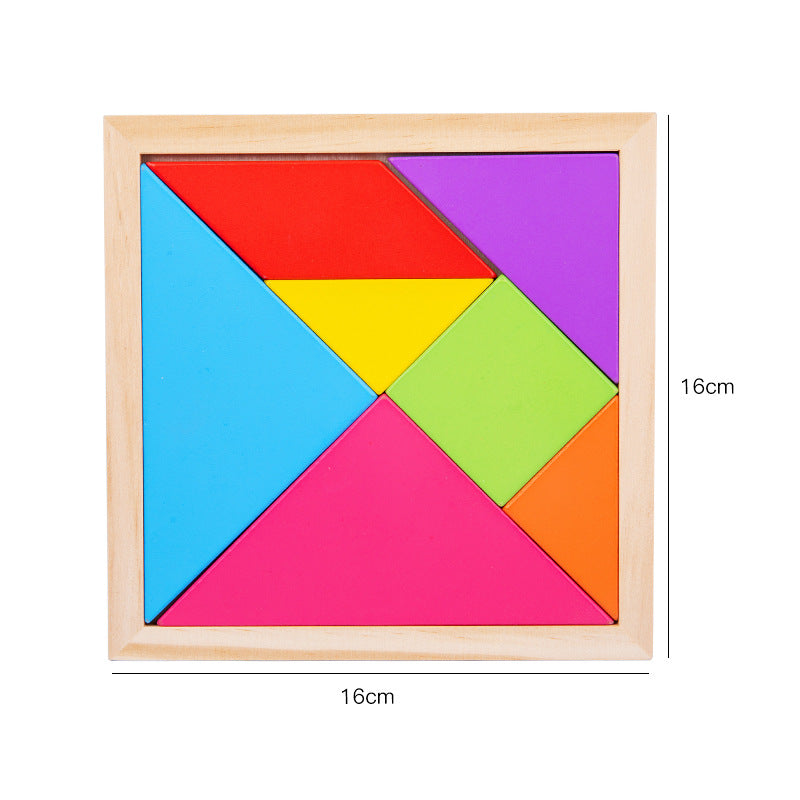
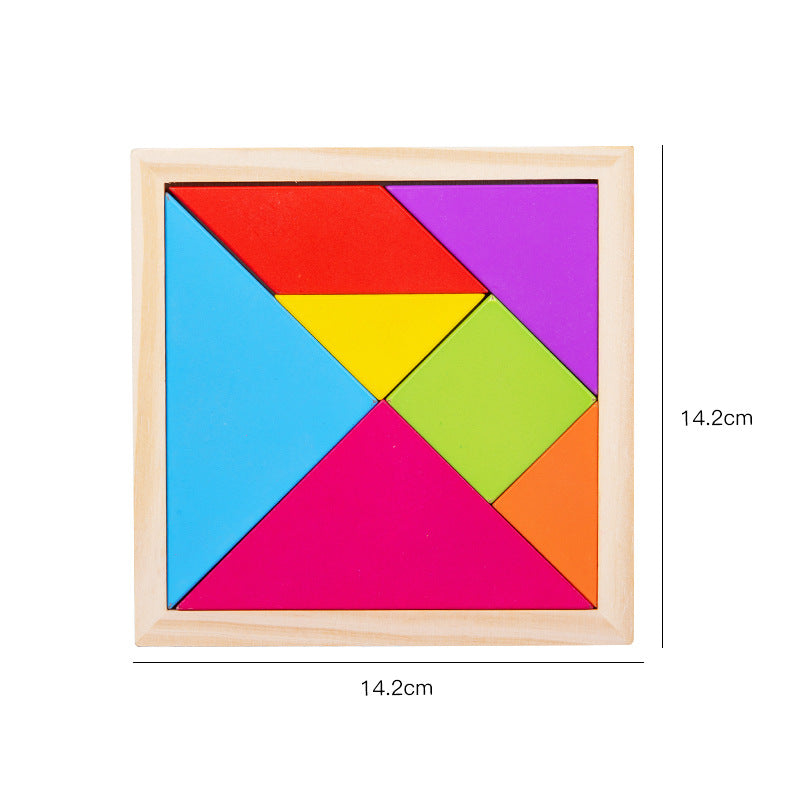
Both editions belong to this single product; choose the edition in the selector to see the appropriate kit. Illustration colors and components follow the selected edition. Product measurements, individual stick lengths and package dimensions are distinct specifications and are not interchangeable.
Materials, Design & Everyday Use
Smooth, brightly colored flat sticks with rounded ends offer an easy-to-see contrast against the illustrated cards. The multicolor finish makes it simple to name colors, compare order, turn shapes and talk about position: above, below, across, beside and in the middle. The challenge-card system makes it easy to start with one or two pieces before building more involved designs. Wipe components gently with a soft, dry cloth, store cards flat and return all loose pieces to the kit after play.
How Parents and Caregivers Can Play
- Start together: choose one card and place just two sticks in front of the child. Point to the first color and say, “Let's put the red one here.” Offer a gesture, model or visual cue before adding verbal instructions.
- Copy one step at a time: build half a picture and invite the child to add the missing stick. Celebrate participation, not speed or perfect accuracy.
- Try position words: ask “Which stick goes on top?” and let the child point, pick up or place the answer. Non-speaking children can take part through gestures and choices.
- Make it social: take turns choosing a card, placing one stick each, or showing the other player what comes next. Practice asking for a piece with words, signs or an AAC device.
- Move from copying to creating: after a familiar pattern, let the child design a road, house, boat or abstract picture and explain it in their own way.
Thoughtful Activities for Different Learning Needs
For autistic children (ASD): offer a predictable sequence—choose a card, match two pieces, take a break and finish. Respect sensory preferences and avoid insisting on eye contact or speech.
For children with ADHD or high activity levels: keep rounds short, allow movement between patterns and invite the child to take a helpful job such as sorting sticks by color. Extend activity time gradually according to interest.
For developmental delays or intellectual disabilities: begin with two contrasting colors, repeated layouts and hand-over-hand assistance only when welcomed. Use clear modeling and allow extra response time.
For motor-planning or fine-motor practice: place larger, widely spaced figures on a stable surface. Encourage reaching, grasping, rotating and careful placement without demanding speed.
These are opportunities for playful participation and skill practice, not medical treatment or a promise of therapeutic outcomes. Adults can adapt activities to the child's interests, communication and support needs.
Montessori & Waldorf-Inspired Activity Ideas
Use the cards for Montessori-inspired self-directed matching and visual problem solving, then remove the templates for open-ended, Waldorf-inspired creative storytelling. This describes play principles, not a formal endorsement or curriculum certification.
Safety & Testing Documentation
Kinmilo maintains CPC and CE testing documentation for its toy range. Adult supervision is essential because the kit includes loose small pieces. Keep away from children under 3 years old and from anyone who may mouth small parts. Please use the kit as an educational activity rather than a food-safe or chewable sensory toy.
Frequently Asked Questions
What is the difference between Edition A and Edition B?
Edition A features spatial color-dot placement activities, whereas Edition B shows classic rainbow pattern sticks with 30 sticks and 20 challenge cards. Select the edition that matches your preferred illustrated activity style.
Can a child with autism play without speaking?
Yes. The adult can model a shape, offer two visual choices and accept pointing, gestures or AAC responses.
What is a good first activity for a child with ADHD?
Choose one short, high-contrast card, build two or three steps and take a movement break before another round.
How can I adapt the task for developmental delay?
Use just two colors and repeat the same simple line or angle until it feels familiar. Add a new piece when the child is ready.
Is this inspired by Montessori or Waldorf education?
Its visual matching invites Montessori-inspired independent exploration while its open-ended shapes support Waldorf-inspired imaginative play.
Can children build their own pictures?
Absolutely. Recreate picture cards or invent original designs and family storytelling scenes.
How should I clean and store the pieces?
Wipe clean with a soft, dry cloth, dry fully before storage, and keep the loose pieces and cards together between sessions.
Couldn't load pickup availability