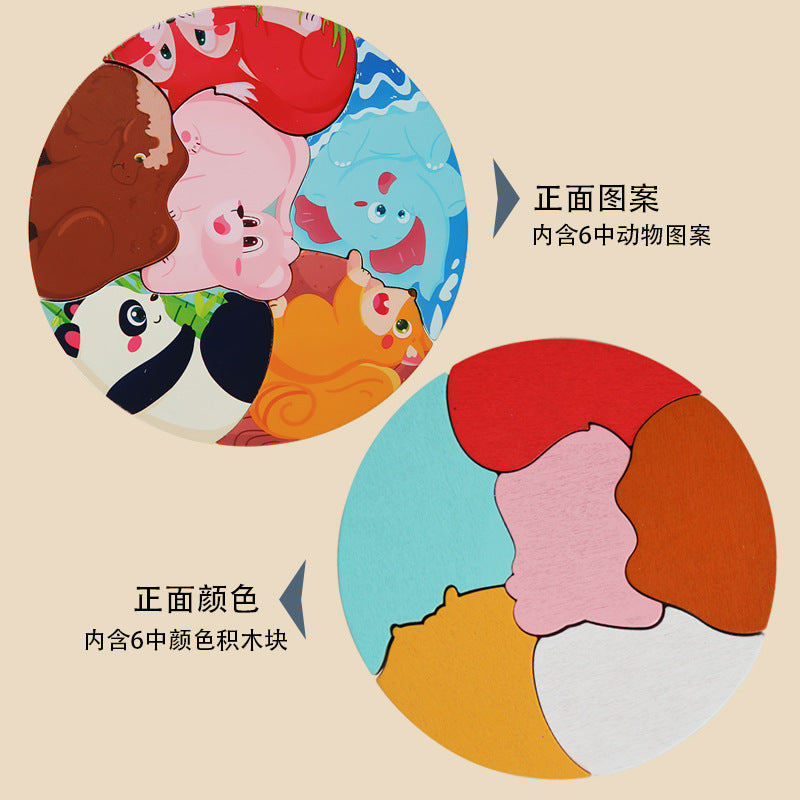
Kinmilo Round Wooden Animal & Nature Inset Puzzle | 8 Themes
Kinmilo Round Wooden Animal & Nature Inset Puzzle | 8 Themes
Discover a World of Animals, Colours and Everyday Stories
The Kinmilo Round Wooden Theme Puzzle brings vibrant illustrated pieces together inside a smooth circular wooden frame. Choose a theme that matches your child's interests, from farm and forest animals to dinosaurs, ocean life, transport and fruit. Each design invites hands-on picture matching, gentle problem-solving and shared conversation at home, in preschools or in caregiver-led activity sessions.
Kinmilo Together Time: A Parent–Child Play Plan
Play Together. Grow Together. Turn Round Wooden Animal & Nature Inset Puzzle into relaxed parent–child interaction. Begin with a short activity, respond to your child's interests and allow breaks.
- 1. Connect & demonstrate: Show one picture, shape or colour and ask 'Where should this go?'
- 2. Share the play: Take turns comparing and placing one piece at a time.
- 3. Grow together: Invite the child to choose a second category or make a two-piece pattern.
Adapt the activity for ADHD, autism and developmental or learning differences
Show just two choices and a visual model; accept pointing, gesture or AAC. For children with different communication needs, invite speech, pointing, gesture, eye gaze or AAC. A predictable start, limited choices and a clear stopping point can make play easier to join.
A note for families: Enjoy connection and meaningful participation rather than speed or perfect answers. These activities offer educational practice opportunities, not a medical treatment or a guaranteed developmental outcome. Follow the product's age and safety instructions, especially for detachable components.
What children can practise through play
- Fine-motor coordination: pick up, turn and position the illustrated pieces.
- Visual discrimination and spatial reasoning: compare outlines, colours and picture details to find the right fit.
- Language and communication: name objects, imitate sounds, point, make choices and tell a short story.
- Patience and attention: work on a small, clear goal, one piece at a time.
Caregiver activity guide: 5 easy ways to play
- Start with two pieces: offer a simple choice and show where one piece belongs.
- Find and name: ask “Where is the dolphin?” or use gestures and picture prompts instead of demanding spoken answers.
- Follow a story: move from “the cow is eating” to a two-step story as the child becomes familiar with the pictures.
- Take turns: a parent places one piece, the child chooses the next; praise effort and participation.
- Build independence: gradually reduce prompts and allow extra processing time before helping.
Using the puzzle with different support needs
Autism (ASD): begin with a preferred theme, use predictable first–then instructions, and allow nonverbal choices. ADHD or high activity levels: offer brief rounds of one to three pieces with movement breaks. Developmental delay or intellectual disability: model the action, simplify the number of choices and repeat familiar routines. Fine-motor challenges: stabilise the frame on a non-slip surface and offer hand-under-hand support if welcomed. Every child participates differently; the activity offers opportunities for practice, connection and confidence without acting as a medical treatment.
Materials and care
Wooden circular puzzle tray with coloured illustrated inset pieces. Wipe gently with a soft, lightly damp cloth and dry before storage. Use with adult supervision, particularly when pieces may present a mouthing risk. Product dimensions differ by design; select the pictured theme above.
Safety documentation
Kinmilo maintains CPC and CE testing documentation for its products. Documentation can be requested from customer support.
Frequently asked questions
Is this suitable for Montessori-inspired learning? Yes. Hands-on choice, self-directed exploration and guided practical activity reflect Montessori-inspired play principles; imaginative storytelling can also complement Waldorf-inspired learning.
Can non-speaking children use it? Yes. A child can participate by pointing, eye gaze, showing a piece, matching pictures or using an AAC communication system.
How do we help when a child gets frustrated? Reduce the number of visible pieces, demonstrate one match, offer a choice and celebrate small steps before increasing the challenge.
Is it a therapy device? No. It is an educational play activity designed to create opportunities to practise skills with caregivers.
Couldn't load pickup availability