Kinmilo Tangram & Magnetic Geometry Puzzle Books | 16 Editions
Kinmilo Tangram & Magnetic Geometry Puzzle Books | 16 Editions
Seven Shapes, Countless Stories: Build, Rotate and Discover
Open a folding puzzle book, arrange pieces on a board, or solve a portable T-shaped geometry challenge. The Kinmilo Tangram & Magnetic Geometry Collection brings related spatial puzzles into one clearly organized listing. Choose your preferred Puzzle Edition for the artwork, format and level of challenge shown in the gallery. Children can copy silhouettes, invent animals and houses, combine triangles into larger shapes, and create their own designs alongside a parent, teacher or caregiver.
Kinmilo Together Time: A Parent–Child Play Plan
Play Together. Grow Together. Turn Tangram & Magnetic Geometry Puzzle Books into relaxed parent–child interaction. Begin with a short activity, respond to your child's interests and allow breaks.
- 1. Connect & demonstrate: Choose one clear shape and demonstrate positioning the first piece.
- 2. Share the play: Take turns fitting pieces into a small pattern or space.
- 3. Grow together: Invite the child to invent a design for you to copy.
Adapt the activity for ADHD, autism and developmental or learning differences
Use two pieces and a finished visual model to reduce complexity. For children with different communication needs, invite speech, pointing, gesture, eye gaze or AAC. A predictable start, limited choices and a clear stopping point can make play easier to join.
A note for families: Enjoy connection and meaningful participation rather than speed or perfect answers. These activities offer educational practice opportunities, not a medical treatment or a guaranteed developmental outcome. Follow the product's age and safety instructions, especially for detachable components.
Find the Right Puzzle Edition
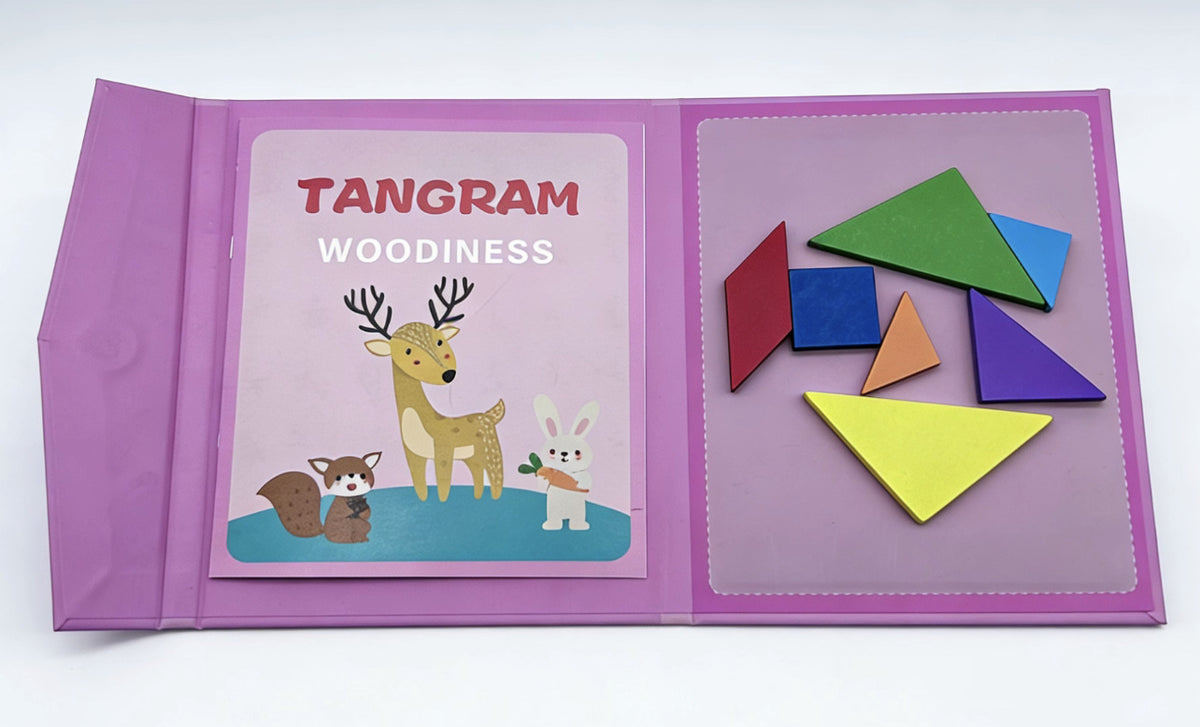
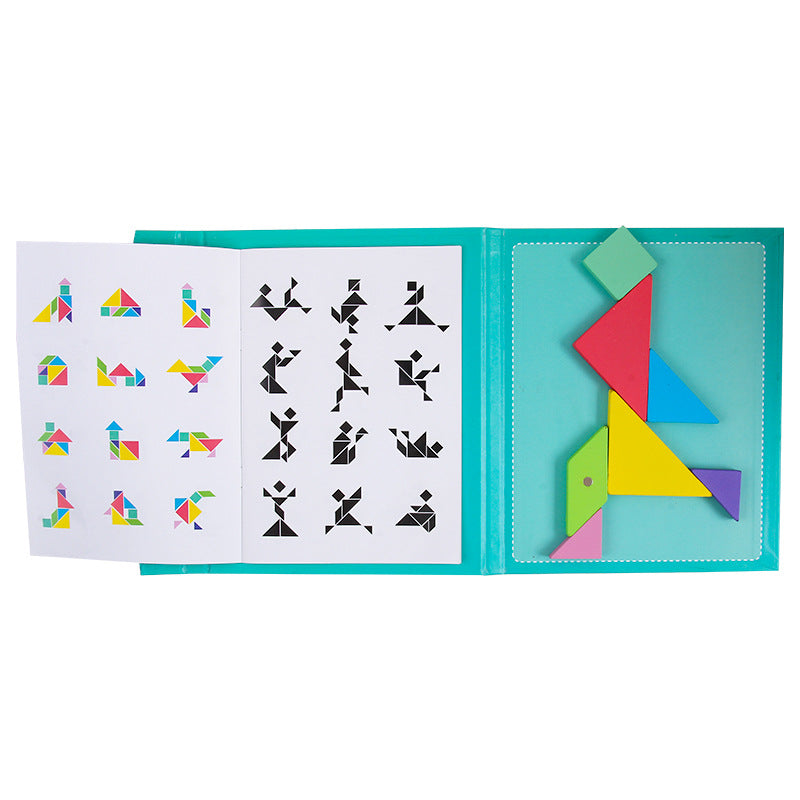
- Magnetic folding book editions: blue, pink, green and purple visual designs that keep a picture-matching activity together in a portable book format.
- Medium-size magnetic books: book-style editions for repeated tabletop matching and travel activities.
- Square board editions: 11.5 × 11.5 cm and 14 × 14 cm geometric tangram boards, with the size referring to the selected board rather than individual pieces or outer packaging.
- T-shaped challenges: a compact flat puzzle or cylindrical magnetic travel edition for rotation and spatial reasoning.
- Story and silhouette activity book: combines picture examples with tangram shape exploration.
The source gallery includes several distinct formats within this puzzle family; piece materials, number of cards, magnetic backing and packaging differ between the selected editions. Select your preferred variant for the matching set. Only the dimensions explicitly stated above are confirmed from the supplied product-option images; they do not describe every version.
How Parents Can Play Along
Stage 1 — Free discovery, no right answer
Place two or three easy-to-hold shapes on the table. Let the child touch, turn and explore. Say “triangle”, “blue” or “turn”, and match your speech to the child's pace. Start with exploring pieces before introducing picture cards.
Stage 2 — One-piece matching
Pick a simple outline or half-finished silhouette. Model placing one shape and invite the child to choose the next piece. To reduce frustration, give two possible shapes rather than the entire pile. Allow the learner to solve the puzzle in their own way.
Stage 3 — Build a story
Create a boat, house, animal or imagined creature, then take turns adding pieces. Invite questions such as “What is it?”, “Where does it go?” and “What happens next?”. Accept spoken replies, gestures or AAC responses.
Adapting Tangram Play for Different Learning Needs
Autism / ASD and sensory preferences
Use a consistent mat or work area and present only a few high-contrast pieces at a time. Begin with a predictable “look–choose–place–finish” routine. Offer visual choice cards or AAC to make the task accessible without requiring speech or eye contact. Some children may prefer repeating a favourite silhouette, and that can be a meaningful shared activity.
ADHD and active learners
Try two-minute puzzle challenges followed by a stretch or movement break. Ask the child to find one color or rotate one piece, then pause. The focus is successful participation rather than staying seated for long periods.
Developmental delay, intellectual disability and motor-planning needs
Use larger, simpler silhouettes and move from matching one shape to a two-shape picture. Demonstrate slowly. Offer stable surfaces, larger pieces where available, supported hand placement or hand-under-hand guidance when welcomed. Repeat activities to offer opportunities for spatial reasoning, persistence and coordination practice.
Communication and social play
Model useful words and AAC messages: turn, same, different, more, help, finished, big, small. Take turns choosing the next shape, and ask the child what the picture could become. A child may participate through looking, pointing, reaching, moving a piece or communicating on a device.
What Can Children Practice?
This open-ended geometry activity offers repeated opportunities to explore shape recognition, visual discrimination, spatial relationships, hand–eye coordination, early problem solving, turn-taking and communication. Each child develops differently; playtime is not a treatment and no developmental outcome is promised.
Materials, Care & Safety
Colorful tactile tangram pieces with illustrated book, board or portable storage formats as shown for the selected version. Wipe clean with a slightly damp soft cloth and dry thoroughly. Keep paper pages and magnetic surfaces away from soaking. Adults should supervise play, especially with loose shapes, small parts and magnetic components; discontinue use if any magnet or component becomes loose or damaged.
CPC & CE Documentation
Kinmilo maintains CPC and CE testing documentation for its children's product range. Product-model documents can be requested through customer service.
FAQ
Does this toy suit a child with autism or ADHD?
Many families can adapt tangram activities to individual preferences using short tasks, clear examples, visual choices and flexible breaks. Begin with the child's interests and level of comfort.
Are the puzzle pieces magnetic?
Choose a magnetic book or magnetic travel edition for that feature. Standard board and flat puzzle editions differ in construction, as shown by their individual variant names.
What size is the tangram?
The photographed square-board options include 11.5 × 11.5 cm and 14 × 14 cm formats. Those are board sizes, not piece or packaging measurements. Other editions have their own form factors.
How should caregivers introduce a tangram puzzle?
Start with two shapes and one simple picture. Show one placement, let the child choose another piece, and close the activity after a successful shared turn.
Is the activity Montessori- or Waldorf-inspired?
Its open-ended hands-on geometry, self-directed shape building and imaginative silhouettes are compatible with Montessori-inspired learning and Waldorf-inspired storytelling, without claiming formal school endorsement.
Can nonverbal children take part?
Yes. Pointing, looking, reaching, guided placement, pictures and AAC messages can all be valid ways to take part.
Expanded Wooden Board Sizes & Travel Editions — 2026 Update
This expanded 16-edition collection also includes a compact 12 × 12 cm classic wooden tangram, a beechwood-framed board measuring 14.9 × 14.9 × 1 cm, a 16 × 16 cm wooden tangram, an 18 × 18 cm wooden tangram, and a green cylindrical travel set with seven colorful geometric pieces. The earlier options remain available in this same product; choose by the Puzzle Edition selector rather than purchasing duplicate listings. Measurements for framed versions describe the whole board, not individual blocks or delivery packaging.
Family & Caregiver Guide: Seven Shapes, Many Paths
- Start with one shape: show a triangle, let the child match or turn it, and talk about its corners with gestures or words.
- Choose the difficulty: begin with an outline containing two pieces before increasing to four or seven shapes.
- Make a two-player picture: the adult adds one piece and the child adds the next, encouraging shared attention and turn-taking.
- Build a story: invite the child to construct a house, boat, bird or imaginary creature and tell a story through pointing, words or AAC.
- Offer independent exploration: let the child try different rotations and flips with no timer, then compare the design with a picture card.
Autism / ASD: use consistent picture prompts, low-clutter setups and predictable beginnings and endings; honor sensory preferences and support non-speaking participation.
ADHD or high activity levels: offer brief shape-building rounds with optional movement breaks and give the child a role such as selecting the next card.
Developmental delays and intellectual disabilities: model one step, simplify the pattern, allow additional processing time and celebrate effort rather than speed.
Fine-motor and visual-spatial activities: practice picking up, rotating and placing shapes on a stable surface with comfortable positioning and adult assistance where helpful.
These are playful practice opportunities, not medical interventions or promised treatment outcomes. The matching and hands-on building reflect Montessori-inspired guided observation; the open-ended animal and story designs also suit Waldorf-inspired imaginative play, without implying an official curriculum endorsement.
Additional FAQ for the New Variants
Are the sizes for the full frame or individual pieces?
The stated centimeter dimensions refer to the complete selected wooden board. Individual tangram pieces and shipping-package measurements are separate.
Is the 18 cm board the same as the 14.9 cm beechwood frame?
No. They are separate selectable sizes. The beechwood version measures 14.9 × 14.9 × 1 cm, whereas the larger board is 18 × 18 cm.
Can a child with autism join without using spoken language?
Yes. Offer a simple model to copy and accept pointing, gestures, assisted choices and AAC responses.
How do we adjust this for ADHD or developmental delay?
Begin with two or three pieces, give one instruction at a time and stop after a short successful round; increase the challenge only when welcomed.
Does the collection have testing documentation?
Kinmilo maintains CPC and CE testing documentation for its toy range. Keep loose puzzle pieces away from children under 3 and supervise activities with small parts.
Couldn't load pickup availability