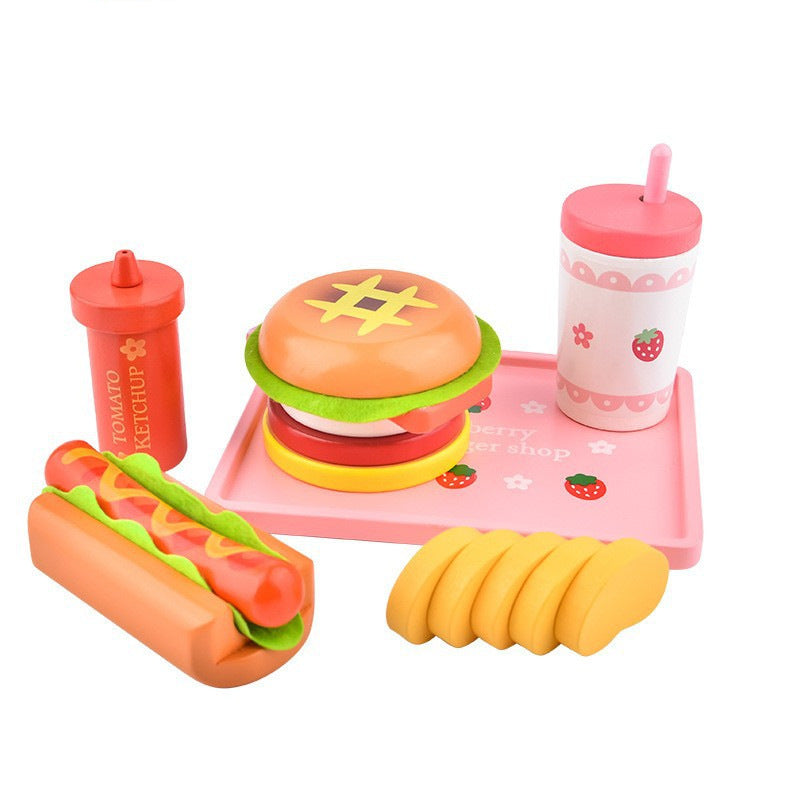
Kinmilo Wooden Burger & Fast Food Pretend Play Sets – 7 Café, Fries & Sandwich Styles
Kinmilo Wooden Burger & Fast Food Pretend Play Sets – 7 Café, Fries & Sandwich Styles
Build a Burger, Share a Story, Practice Everyday Skills
Bring a family café, takeaway counter or make-believe diner to the play table with Kinmilo's Wooden Burger & Fast Food Pretend Play Collection. Choose from seven available styles, from layered wooden hamburgers and sandwich puzzles to fries, drinks, serving trays and order cards. Each style is a separate selectable set within this single product listing; contents and sizes differ by selection.
What's Special About This Pretend Food Collection?
- Open-ended café role play: children can take turns as chef, customer or server, take orders and set the table.
- Hands-on assembly: stack the bun and fillings, match the picture card to a model, or group the food pieces by category.
- Early communication: easy phrases such as “I want fries,” “one burger, please,” “my turn,” and “all done” are naturally meaningful in play.
- Montessori-inspired practical-life activities: sorting, sequencing, serving and putting objects back in their place.
- Imaginative Waldorf-compatible play: the food pieces also encourage child-created stories and unstructured pretend scenarios. This is a design connection, not a claim of formal Montessori or Waldorf endorsement.
Choose Your Set — Seven Detailed Variants
| Selected Style | What's Pictured | Recorded Weight | Recorded Retail Box Dimensions |
|---|---|---|---|
| 01 — Burger & Fries Café Set | Wooden burger, fries, sauces and pretend serving/order pieces | 0.8 kg | 13 × 10.5 × 21 cm |
| 02 — Red Takeaway Burger Combo | Hamburger, fries, drinks and red takeaway-style accessories | 0.7 kg | 20 × 10 × 10 cm |
| 03 — Takeaway Burger Meal Box | Fast-food takeaway burger and fries combination | 0.7 kg | 15 × 15 × 17 cm |
| 04 — Breakfast Burger Tray Set | Hamburger, side items, serving tray and drink | 0.6 kg | 25.6 × 7 × 18.7 cm |
| 07 — Stacking Hamburger Puzzle | Layered wooden burger with reusable picture/order play | 0.3 kg | 10 × 9.5 × 8.5 cm |
| 08 — Stacking Sandwich Puzzle | Stackable pretend sandwich and picture-based recipe play | 0.3 kg | 10 × 9.5 × 8.5 cm |
| 09 — Wooden French Fries Set | Play fries and takeaway-style container | 0.22 kg | 14 × 12 × 6 cm |
Dimensions explained: values above are retail package/colour-box dimensions taken from the pictured specification sheet, not the assembled toy's footprint. Shipping-carton measurements on the original sheet refer to multiple units and are not individual product sizes. Contents vary by style; choose your preferred variant in the selector.
Materials, Craft and Care
The photographed selection features shaped and painted wooden play-food components, with printed menu/order cards and presentation accessories for the relevant styles. Pieces are shaped for repeated handling and imaginative assembly. Wipe wooden components with a slightly damp cloth; dry immediately. Keep printed paper components dry and store the complete set away from heat and standing water. These are pretend foods, not edible items and not real cooking utensils.
A Parent's Five-Stage Play Guide
1. Start with Connection, Not Correct Answers
Sit at the child's level and invite them to choose just one piece: “Which food shall we make?” Model a simple action yourself. A child can participate by looking, pointing, reaching, signing, using an AAC device or speaking.
2. Build a Predictable Three-Step Routine
Try “Choose the bun → add a filling → serve the burger.” Put the pieces in left-to-right order or show one picture at a time. For children who thrive on predictability, keep the sequence the same until they ask for change.
3. Practice Attention and Turn-Taking
For children with ADHD or high activity levels, use short rounds of 2–5 minutes, let them stand or move between orders, and make the finish line clear: “Two more orders, then tidy up.” Avoid making sitting still the goal.
4. Adapt the Activity for Autism, Developmental Delay or Intellectual Disability
For an autistic child who enjoys patterns, match burger layers to an order card or sort items by shape. Offer a small choice of two objects instead of displaying the whole set. For a child with developmental delay or intellectual disability, begin with matching identical pieces, then progress to a two-step “make and serve” game. Reduce language, demonstrate with your hands and celebrate participation in the child's own communication style.
5. Extend to Real-Life Conversations
Invite an older sibling or caregiver to be the customer. Use “May I have…?”, “Here you go,” “Thank you” and “Your turn.” For emerging speech or AAC users, offer corresponding picture symbols and allow extra response time. Fine-motor practice can include grasping a bun, placing a layer, serving a plate and returning the fries to their container.
Family and Classroom Activity Ideas
- Picture Recipe: create a photo sequence for a simple two-layer burger.
- Order Counter: use one or two item requests as communication practice.
- Sorting Café: separate drinks, mains, sauces and sides.
- Memory Order: display three pieces, cover them and ask which one is missing.
- Calm, Shared Play: use a familiar routine without imposing eye contact or forced interaction.
Safety and Documentation
Recommended for ages 3+ with adult supervision, especially when sets include detachable small components. Kinmilo maintains CPC and CE testing documentation for its products. Keep small parts out of reach of children who mouth toys. Activities are educational play opportunities, not medical treatment or a promise of developmental progress.
Frequently Asked Questions
Is this suitable for children with ADHD?
Yes, parents can use the clear, hands-on tasks in brief active play sessions to create opportunities for sequencing, choice-making and cooperative play. Adjust the pace and movement breaks for your child.
How can I introduce this to an autistic child?
Start with familiar visual matching, a choice of two food pieces and predictable steps. Welcome speech, gesture, pictures or AAC as equally meaningful communication.
Can children with developmental delays use the toy?
Caregivers can simplify the task to one piece at a time, model each action and gradually add steps as the child shows interest.
Does it support Montessori or Waldorf-style learning?
Its open-ended design offers Montessori-inspired hands-on choice, sequencing and practical-life play as well as imaginative storytelling often associated with Waldorf-style activities.
Are the set dimensions the same?
No. The table above gives variant-specific retail box dimensions and recorded weights. Toy pieces differ across styles.
Are CPC and CE documents available?
Kinmilo maintains product testing documentation for the range. Our support team can assist with the relevant reports.
Is it suitable for a preschool classroom?
Yes, a caregiver or educator can organize supervised small-group pretend restaurant play and set up age-appropriate, accessible roles.
Couldn't load pickup availability