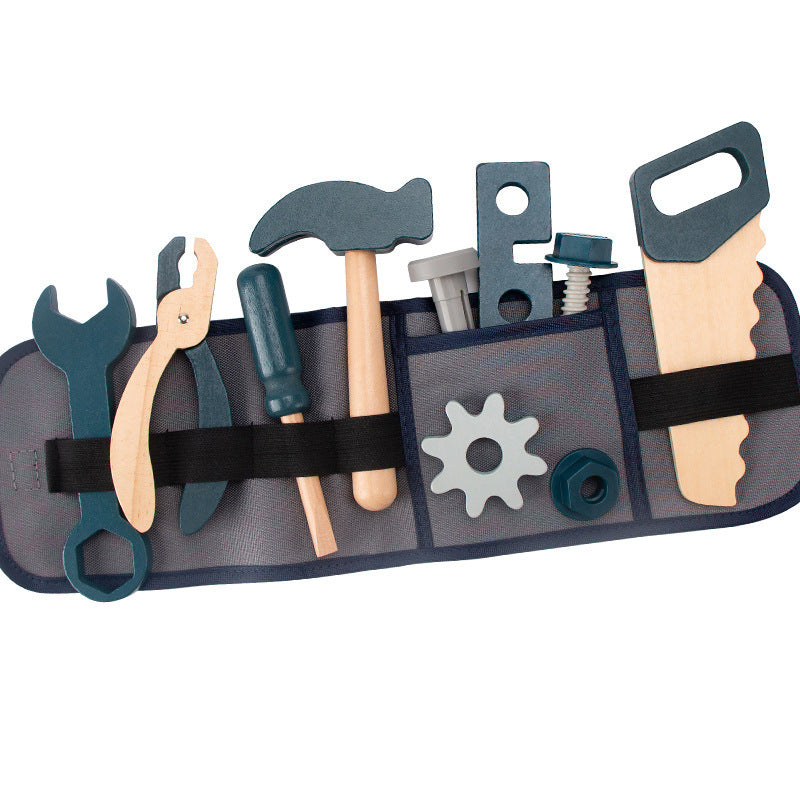
Kinmilo Wooden Career Role-Play Utility Belts – 6 Community Helper Sets
Kinmilo Wooden Career Role-Play Utility Belts – 6 Community Helper Sets
Six Community Helpers and Endless Stories
Children can become a doctor, firefighter, mechanic, hairdresser or traffic officer in their own pretend city. Each wooden toy utility belt holds pretend profession-specific accessories, offering natural opportunities for role-play and conversation.
Kinmilo Together Time: A Parent–Child Play Plan
Play Together. Grow Together. Explore Wooden Career Role-Play Utility Belts as a shared parent–child activity. Begin with one short, enjoyable interaction and follow your child's pace.
- 1. Connect & demonstrate: Choose one outfit, face or character and model one change.
- 2. Share the play: Take turns deciding how the character looks or what job they might do.
- 3. Grow together: Act out a short story: get ready, help someone, return home.
Inclusive play for ADHD, autism and different developmental or learning needs
Use two choices, visual prompts and optional gesture or AAC without demanding eye contact. Children can join through words, actions, pointing, eye gaze, signs or AAC. Offer short rounds, visual prompts and control over breaks as needed.
Caregiver note: Build moments of connection and participation, not a test of speed or correctness. These are educational practice opportunities, not treatments or guarantees of progress. Follow the specific product's age and safety advice, with supervision around detachable parts.
What You Receive and Dimensions
Wooden painted imitation tools and a fabric utility belt with adjustable fastening. Belt laid flat: approximately 69.5 × 13 × 0.5 cm; central tool area about 40 cm. Gift box 24 × 15 × 6 cm; weight around 0.4 kg. Each variant features its corresponding professional props; all pictured occupations are not included together. Tools are strictly pretend-play accessories.
Interactive Parent and Child Activity Plan
- Offer a choice of two pretend jobs; let the child pick with words or pictures.
- Take out one tool and talk about what a helper would use it for.
- Model a simple story such as “The bicycle needs fixing” or “The doll needs a check-up.”
- Let the child request or hand over props, practising sharing and friendly communication.
- Return the tools to the belt together and move to another rescue or service mission.
Use a short, predictable script for a child who likes structure. Children with high activity levels may enjoy walking between imaginary stations; children with movement limitations can use the belt laid flat on a table.
How to Adapt Play for Different Needs
Autism spectrum / ASD: Begin with a predictable, low-pressure one-step activity. Offer a visual example and let the child respond through words, gestures, pointing or AAC; follow their sensory preferences rather than forcing contact or performance. ADHD and high activity levels: Turn play into short hands-on missions, add movement breaks and let the child return to a task without pressure. Developmental delays and intellectual disabilities: Model each action, simplify choices to two objects, repeat routines, and celebrate engagement instead of speed. Physical or motor disabilities: Position the toy at comfortable reach, stabilize it, and let the child select or direct a caregiver even when help is needed to handle parts.
These activities offer opportunities to practise attention, communication, sequencing, confidence, imagination, fine-motor coordination or problem-solving through shared play. They are not a medical treatment and do not promise improvements in any diagnosis.
Montessori & Waldorf Inspired Learning
Practical hands-on exploration and the freedom to invent a personal story reflect Montessori child-led discovery and Waldorf-inspired imaginative play. Caregivers can adjust the pace, words, and demands to every learner.
Product Care & Testing
Recommended for supervised play from age three where small parts are present. Adult supervision is essential for children who mouth objects. Inspect detachable parts regularly. Clean with a soft damp cloth and dry fully. Kinmilo's CPC and CE testing documentation can be requested for the selected toy.
Frequently Asked Questions
Q: How do I begin play with my autistic child?
A: Start with one favored piece and one clear instruction. Make room for nonverbal communication, sensory preferences, and independent exploration.
Q: Is this suitable for a child with ADHD or developmental delays?
A: Short engaging activities, demonstration and repeated practice can be adapted to different attention and developmental needs.
Q: Can a child with limited motor control participate?
A: Yes. Support the toy, offer accessible choices and let the child direct the game.
Q: Are CPC and CE testing reports available?
A: Contact Kinmilo to request the product-specific documentation.
Couldn't load pickup availability