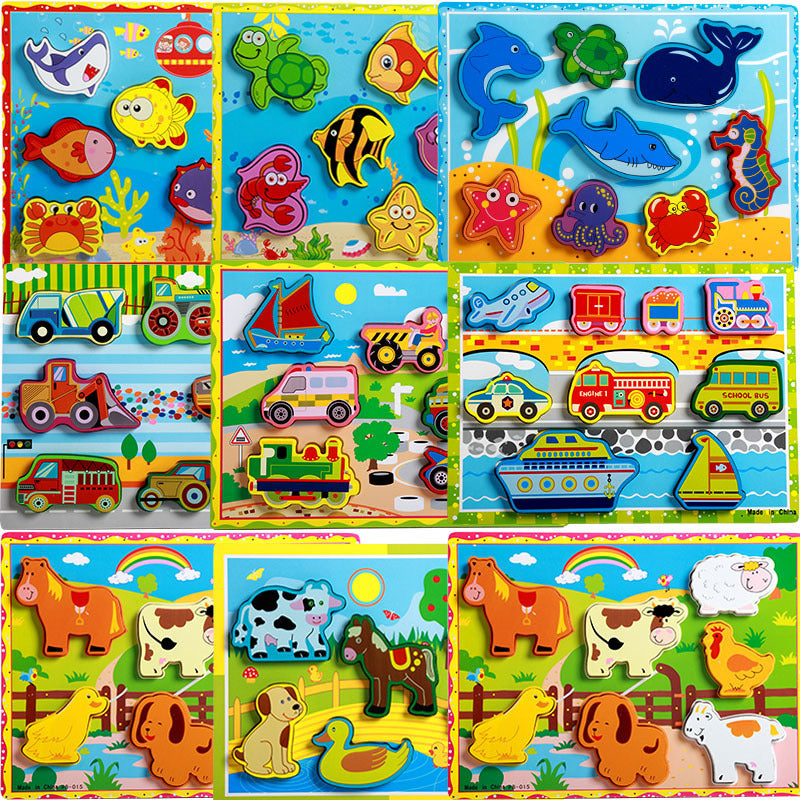
Discover, Match, Name and Play — One Wooden Puzzle, Many Ways to Learn
Kinmilo's Wooden Early Learning Puzzle Boards bring colorful animals, vehicles, fruits, shapes, letters and numbers into a hands-on matching experience. Choose a themed board to suit your child's interests, and explore the same familiar pieces through matching, sorting, storytelling and turn-taking. The range includes easy-to-grip wooden inset pieces and illustrated grip-board designs, with the exact style shown in each theme's photographs.
Kinmilo Together Time: A Parent–Child Play Plan
Play Together. Grow Together. Use your Wooden Early Learning Puzzle Boards as a starting point for relaxed, child-led interaction. Try one short activity, and follow your child's interests, developmental stage and comfort.
-
1. Connect & demonstrate: Show one number, counter or bead. Model a simple action: “Here is one. Let's add one more.”
-
2. Share the play: Take turns moving or placing a counter while counting together, or simply match a number to a group of objects.
-
3. Grow together: Introduce one small comparison such as “Which has more?” or let the child invent a counting challenge.
Adapt play for ADHD, autism and different learning needs
Start with one to three objects for children who need simpler steps. Use concrete visual groups, gestures and AAC; celebrate attempts rather than speed or correct answers.
Caregiver tip: Children can respond through speech, gestures, pointing, eye gaze or AAC. Support their choices, avoid forcing performance, and celebrate moments of shared play. These are opportunities for learning and connection, not treatment for ADHD, autism or learning disabilities and not a guarantee of a particular outcome. Follow the product-specific age and safety guidance.
What Children Can Explore
-
Fine-motor practice: lift, rotate and place wooden pieces into their matching spaces.
-
Visual matching and spatial awareness: look for shape outlines, colors, pictures and correct orientation.
-
Early communication: choose, point, gesture, use AAC, imitate sounds or name familiar pictures.
-
Early literacy and numeracy: discover letter shapes, number symbols and visual patterns on the corresponding themed boards.
-
Shared attention and turn-taking: take turns choosing a piece, giving a clue and completing a small task together.
How Parents and Caregivers Can Play
-
Start with two choices: offer just two pieces. Say or show “find the fish” or “which one fits?” and allow time to respond by pointing, looking, signing or speech.
-
Model once: gently demonstrate turning and fitting a piece, then invite the child to try independently. Praise the effort rather than demanding a perfect match.
-
Make a little story: use animal sounds, vehicle destinations or fruit-shop pretend play to extend the activity beyond a single correct answer.
-
Sort and compare: group the pieces by animals, colors, number shapes or transport themes. Ask “same or different?” and welcome non-verbal answers.
-
Finish with a simple routine: celebrate one successful turn, put the pieces back together and repeat the same predictable sequence on another day.
Adaptable Play for Different Learning Needs
Autism / ASD: use a consistent order, a visual first–then cue and a small selection of pieces to reduce competing demands. Respect sensory preferences and let the child choose their own response style.
ADHD and high activity levels: try a brief, achievable round of two to four matches with an optional movement break, then return to another mini-round. Keep instructions short and concrete.
Developmental delay or intellectual disability: begin with one clearly contrasting shape, repeat a familiar step, offer demonstration or light assistance when welcomed, and build gradually toward more pieces.
Physical or fine-motor disabilities: position the board on a steady surface or non-slip mat and allow extra time. The activity can also be completed through pointing and caregiver-assisted placement.
AAC and emerging communication: offer “more,” “help,” “my turn,” animal picture choices or yes/no responses through gestures, communication cards or a speech-generating device. Spoken answers are not required.
Styles and Materials
Illustrated wooden puzzle boards with colored wooden pieces. Select a learning theme from the options: farm animals, ocean animals, jungle animals, transport, fruits, tools, alphabet, numbers, geometry or mixed picture scenes. Themes and piece profiles differ; choose by the exact variant name and photographed design.
Dimensions
Illustrated wooden grip board shown in the size diagram: approximately 30 × 22.5 × 0.5 cm (board length × width × board thickness, excluding raised handles). This measurement belongs to the pictured grip-board format, rather than every chunky inset board. The photographs show the construction of each theme; individual puzzle pieces are not the packaging dimensions.
Safety and Care
Kinmilo maintains CPC and CE testing documentation for this product range. Use with adult supervision, especially where removable small pieces are present. Keep small pieces away from children who may mouth or swallow them. Wipe with a soft, slightly damp cloth and dry thoroughly; do not immerse the wood.
Frequently Asked Questions
Is this inspired by Montessori or Waldorf education?
Yes. The hands-on matching and child-led exploration align with Montessori-inspired practical learning; the picture pieces also lend themselves to Waldorf-style imaginative storytelling.
Can a child who does not use spoken language enjoy this?
Absolutely. They can choose pieces by looking or pointing, make requests through AAC, and take turns with a caregiver. The goal is shared exploration, not a spoken test.
How can I make the activity easier?
Begin with one or two easy pieces, rotate the board toward the child, model the move once and celebrate small attempts before increasing the challenge.
Are all themes identical in size and construction?
No. The range includes different wooden inset and grip-board designs. The 30 × 22.5 × 0.5 cm specification refers to the grip board shown in its measurement image.