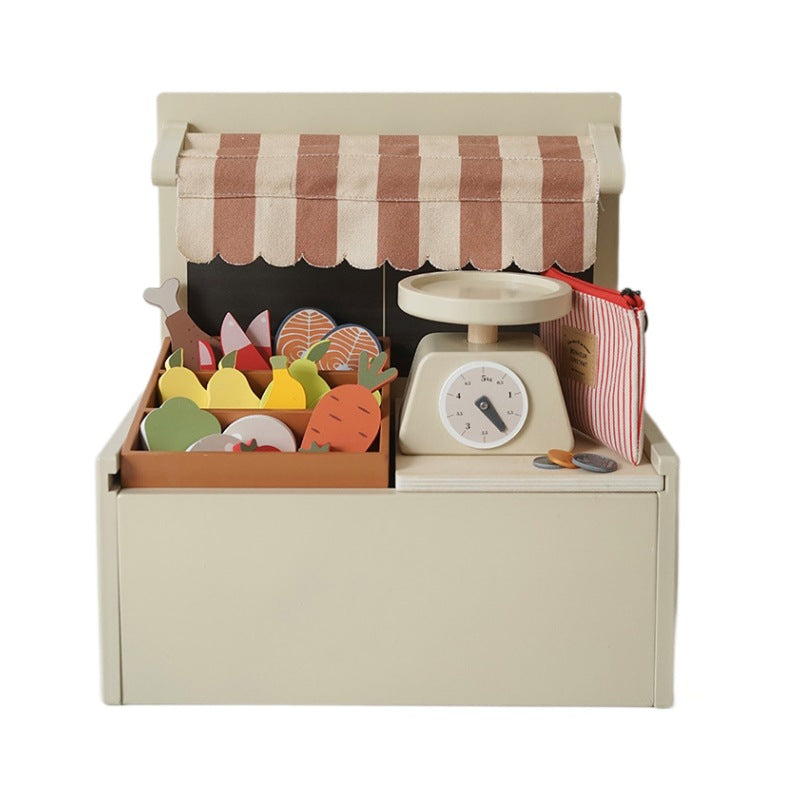
Kinmilo Wooden Farmers Market Stall with Toy Scale, Play Food & Coins – Montessori-Inspired Grocery Role Play
Kinmilo Wooden Farmers Market Stall with Toy Scale, Play Food & Coins – Montessori-Inspired Grocery Role Play
A Little Farmers Market, a Big World of Everyday Discovery
Welcome to the Kinmilo Wooden Farmers Market: a beautiful, hands-on miniature grocery stall for little shopkeepers, thoughtful customers and imaginative family play. Arrange the colorful pretend fruit, vegetables, meat and fish pieces in the divided produce tray; lift the striped fabric canopy; place an item on the wooden toy scale; and take turns paying with play coins. The fold-away stall provides a practical storage space when the day's shopping adventure is finished.
Designed for screen-free, child-led pretend play, this set introduces familiar daily-life routines in a way children can see, touch, describe and repeat. Its gentle cream-colored wooden counter, warm-toned display tray and fabric awning create a calm yet engaging play setting.
What Children Can Explore
- Communication and vocabulary: name fruit, vegetables and foods; ask for an item; respond to simple shopping questions.
- Fine-motor practice: pick up, place, sort and return wooden food pieces and play coins.
- Early maths: count apples, compare quantities, pretend to weigh a purchase and exchange play money.
- Planning and everyday sequences: choose, weigh, pack, pay and tidy up.
- Cooperative play: practice taking turns as the shopkeeper and customer.
How Parents and Caregivers Can Play Together
Activity 1 — Find My Grocery Item (5 minutes)
Place just three food pieces on the counter and name one: “Can you find the carrot?” Allow time for pointing, looking, reaching or speaking. When the child makes a choice, place that food on the scale together. Gradually move from single-word prompts to “I would like one carrot, please.”
Activity 2 — Shop, Weigh and Pay
Give your child a short shopping mission: pick an item, place it on the toy scale, then hand a coin to the seller. Model each action before inviting a turn. For extra maths practice, count one, two or three coins and compare two piles of produce. The scale is for imaginative role play rather than calibrated measurement.
Activity 3 — Build Your Own Market Story
Take turns being the shopkeeper. Ask “What would you like today?”, offer a food piece, collect pretend payment and say “Thank you for shopping.” Invite a sibling or grandparent to join. Encourage the child's ideas, gestures or communication aids instead of insisting on scripted speech.
Inclusive Play Ideas for Different Learning Needs
For children with ADHD or high activity levels
Use short, active rounds with one clear goal at a time: “find it, weigh it, pay for it.” Let the child move between collecting food, sorting the counter and being the customer. A visual checklist of three steps can help make the game predictable without turning play into a test.
For autistic children (ASD)
Begin with a familiar routine and a small selection of foods. Show the sequence using photos or simple picture cards; model a turn, then invite the child to copy or develop their own version. Keep sensory input comfortable, respect communication preferences, and allow repeated favorite activities.
For developmental delay or intellectual disability
Start with matching one picture to one object or sorting two easily recognized foods. Offer hand-under-hand guidance only when welcomed, celebrate participation, and repeat an achievable task before adding new steps. The activity can be enjoyed through pointing, gestures or words.
For children with physical disabilities or fine-motor challenges
Place the market at a reachable table height and bring the tray close to the child's preferred hand. Offer larger food pieces first and focus on grasping, releasing, and placing rather than speed. Adapt the activity for seated play and offer assistance where needed.
These ideas create opportunities to practice engagement, communication, coordination and everyday routines. This is an educational play resource, not a medical treatment or a substitute for individualized professional support.
Materials, Size and Details
- Main material: wood with a striped fabric canopy and illustrated play food pieces.
- Assembled dimensions: approximately 31.3 cm wide × 22 cm deep × 32.5 cm high (12.32 × 8.66 × 12.80 in).
- Base counter height: approximately 14 cm.
- Retail box dimensions: approximately 34 × 24 × 16 cm; these are packaging dimensions, not the assembled toy dimensions.
- Reference weight: approximately 3.3 kg as listed in the product specification image.
- Play components shown: market stand, striped canopy, display tray, illustrated pretend food, toy weighing scale, play coins and striped storage pouch.
- Age and supervision: recommended for ages 3+ with adult supervision; contains small play accessories.
- Product testing: Kinmilo maintains CPC and CE testing reports for this toy range; contact Kinmilo if you need the applicable documentation.
Care and Storage
Wipe wooden surfaces with a slightly damp cloth, then dry fully. Spot-clean the fabric canopy and pouch. Avoid soaking, extended direct sunlight, and harsh cleaning agents. Count loose coins and accessories after play; store all pieces inside the stall and keep small parts away from children under three.
Frequently Asked Questions
Is this inspired by Montessori or Waldorf play?
Yes. The open-ended, child-led activities reflect Montessori-inspired practical-life exploration and Waldorf-inspired imaginative storytelling. It is a pretend-play product, not an officially endorsed curriculum material.
How can I use this with a child who is not yet speaking?
Offer a choice between two food pieces and accept eye gaze, pointing, signing, an AAC device or spoken words. Model the shopping interaction without pressuring the child to speak.
Can this help children practice counting?
Yes. Parents can use the pretend coins and food pieces to offer age-appropriate opportunities for counting, comparing and turn-taking.
Does the toy scale measure real weight?
No. The scale is a role-play accessory designed for pretend grocery shopping.
What is the size of the product?
The assembled market measures approximately 31.3 × 22 × 32.5 cm. The separate retail packaging measures approximately 34 × 24 × 16 cm.
Is this an appropriate activity for autism, ADHD or developmental delay?
It can be adapted for many play styles and abilities, with short routines, picture prompts, accessible placement and caregiver participation. Choose activities according to each child's comfort, interests and abilities.
Do you have CPC and CE testing documents?
Kinmilo maintains CPC and CE testing reports for this toy range. Contact our customer-support team for documentation relevant to the product.
Couldn't load pickup availability