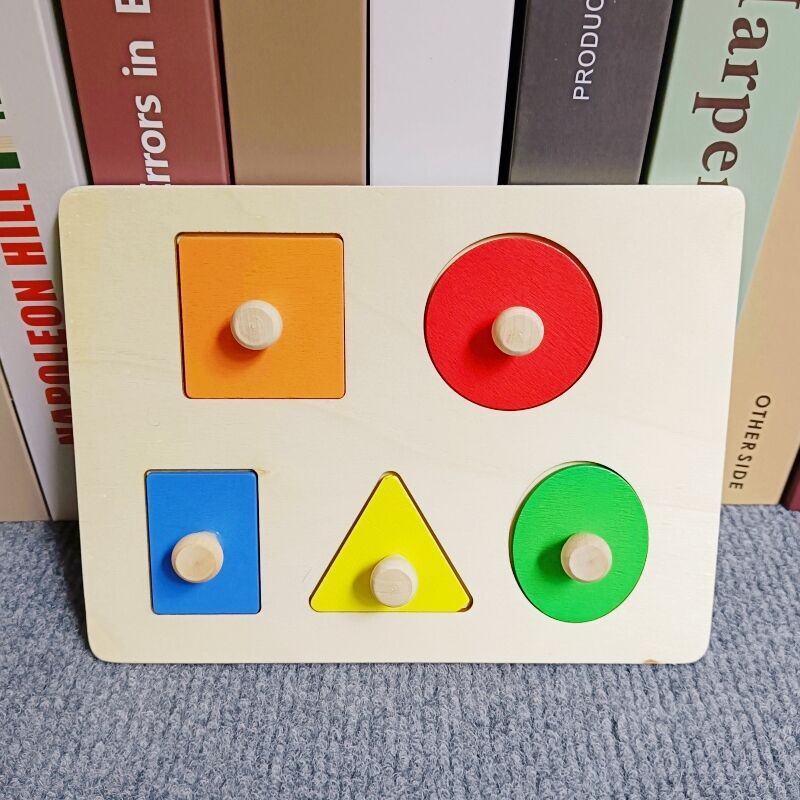
Kinmilo Wooden Geometric Shape Peg Puzzles | 8 Montessori-Inspired Sorting Board Designs
Kinmilo Wooden Geometric Shape Peg Puzzles | 8 Montessori-Inspired Sorting Board Designs
Small Shapes, Big Discoveries: Wooden Peg Shape Sorting Boards
Explore a colorful family of natural wood shape puzzles without buying a different learning concept for each stage. Choose the format best suited to your child: individual matching tiles, a three- or five-shape strip, a round size-comparison board, larger multi-shape boards, or a number-learning format. Each design invites children to grasp a wooden peg, notice its color and outline, and guide it back to a matching recess.
Kinmilo Together Time: A Parent–Child Play Plan
Play Together. Grow Together. Turn Wooden Geometric Shape Peg Puzzles into relaxed parent–child interaction. Begin with a short activity, respond to your child's interests and allow breaks.
- 1. Connect & demonstrate: Choose one clear shape and demonstrate positioning the first piece.
- 2. Share the play: Take turns fitting pieces into a small pattern or space.
- 3. Grow together: Invite the child to invent a design for you to copy.
Adapt the activity for ADHD, autism and developmental or learning differences
Use two pieces and a finished visual model to reduce complexity. For children with different communication needs, invite speech, pointing, gesture, eye gaze or AAC. A predictable start, limited choices and a clear stopping point can make play easier to join.
A note for families: Enjoy connection and meaningful participation rather than speed or perfect answers. These activities offer educational practice opportunities, not a medical treatment or a guaranteed developmental outcome. Follow the product's age and safety instructions, especially for detachable components.
Learning Through Touch and Trial
- Shape recognition: distinguish circles, squares, rectangles, triangles, hearts, stars and other outlines shown by the selected design.
- Visual discrimination: search for a matching contour or compare differently sized circles.
- Fine-motor practice: use the rounded central pegs to lift and place pieces with deliberate hand movement.
- Early problem-solving: rotate a piece, test an opening and adjust the angle.
- Language-building play: introduce simple requests such as “red circle”, “big one” and “your turn”.
Caregiver Guide: Four Easy Games
- One shape at a time: remove one shape, show its recess and offer an unhurried turn to put it back.
- Two-choice matching: set out a circle and triangle. Ask the child to find one by pointing, touching or placing.
- Big-to-small: with the round circle board, compare relative sizes and sort by looking and feeling.
- Color-and-action game: say, “Pick up the blue square and put it home.” Demonstrate first, then simplify the instruction when needed.
Adapted Play for ASD, ADHD and Developmental Delays
ASD and sensory preferences: create a calm play area, keep the board orientation consistent and start with just one or two pieces. A visual cue and predictable turn-taking routine can make the activity easier to follow.
ADHD and active learners: turn shape matching into brief challenges with a clear start and finish; take natural breaks and switch formats to renew interest.
Developmental delay and intellectual disability: repeat the same two-shape pattern across sessions and build toward more choices. Children can indicate a match by gesture, not only by speaking.
Fine-motor differences: present a piece near its opening, help steady the board and allow extra time for picking up and positioning. Praise effort and self-directed exploration rather than speed.
This is open-ended educational play that offers chances to practise attention, coordination, categorization and communication; it is not a treatment for any diagnosis.
Designs and Verified Dimensions
- 3-Shape Strip: approximately 20 × 7.7 cm.
- Three Graduated Circles: approximately 20 × 9.7 cm.
- Individual Shape Tiles: approximately 7.7 cm wide per tile.
- 5-Shape Long Strip: approximately 29.8 cm long.
- 6-Shape Board: approximately 20 × 14.8 cm.
- 12-Shape Board: approximately 30 × 20 cm.
- Round Size-Matching Board: approximately 19.7 cm across.
- Number-Learning Format: numerals 0–9, as pictured.
Dimensions refer to the boards or tiles shown in the dimension illustration, not shipping-box dimensions. Contents and combinations depend on the selected design.
Materials and Care
Wooden bases and brightly colored wooden inset pieces with easy-to-grasp peg handles. Clean with a slightly damp cloth, then dry straight away; keep away from prolonged soaking. Tidy loose pieces together when play is finished.
Product testing documentation: Kinmilo maintains CPC and CE testing documentation for this product range. Use with adult supervision and follow age-appropriate play practices.
Frequently Asked Questions
Q: Is every pictured board included?
A: Choose the design from the variant selector. Each choice corresponds to its own board or tile format; photos across the gallery show the available family of designs.
Q: Which option is best for a beginner?
A: The three-shape strip offers fewer choices and a shorter matching sequence.
Q: How can an autistic child use this activity?
A: Start with predictable sorting rounds, use a simple demonstration and let the child select or match without demanding speech.
Q: Can children with ADHD use it?
A: Yes. Short, movement-friendly turns offer a manageable activity structure.
Q: Is this Montessori or Waldorf inspired?
A: The tactile self-directed matching is Montessori-inspired, and its open-ended sorting and imaginative color stories also fit Waldorf-inspired play.
Q: What should I do if a piece does not fit?
A: Guide your child to compare outlines, rotate gently and find the matching opening without forcing the piece.
Couldn't load pickup availability