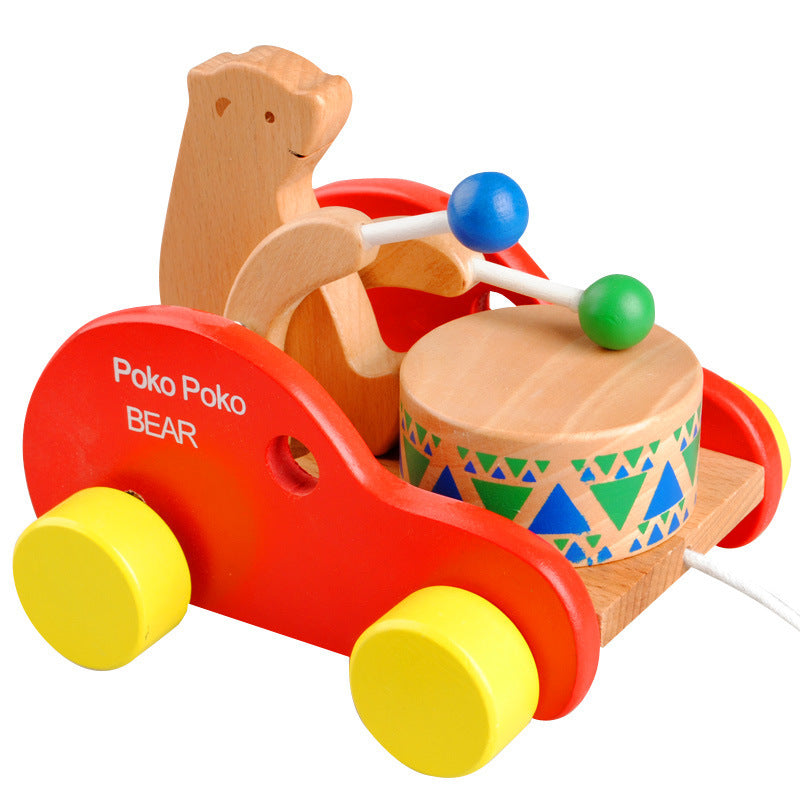
Kinmilo Wooden Pull-Along Drumming Bear – Musical Walking & Cause-and-Effect Toy
Kinmilo Wooden Pull-Along Drumming Bear – Musical Walking & Cause-and-Effect Toy
Little Steps, Happy Beats: Meet the Pull-Along Drumming Bear
A smiling wooden bear, a bright red four-wheeled cart and a cheerful little drum create a wonderful reason to move, listen and play together. As the Kinmilo Wooden Pull-Along Drumming Bear rolls forward, the bear's moving arms tap the drum with colorful beaters, turning a simple pull into a delightful sound-and-motion surprise.
Designed for parent-guided movement and musical discovery, this classic battery-free play companion offers an approachable way to explore rhythm, action and reaction, coordinated movement, early communication and imaginative storytelling.
Details Children Will Want to Explore
- Action-powered drumming: Rolling the four wheels operates the bear's arms and drumbeat—no batteries or electronic sound required.
- Solid beech-wood construction: Smooth wooden components with rounded edges, colorful red side panels, yellow wheels and patterned drum.
- Friendly character design: A bear with two rotating drum arms and contrasting blue and green beater heads.
- Pull cord and handhold: A pull cord with an end bead makes stop-and-go activities possible with an adult nearby.
- Open-ended rhythmic play: Roll slowly, pause to listen and change direction to create new play moments.
Verified Product Dimensions
| Complete assembled toy | 16 × 14 × 14 cm (approximately 6.3 × 5.5 × 5.5 in; height, width and depth as illustrated) |
|---|---|
| Pull cord | Approximately 95 cm as shown in the dimension image |
| Product weight | Approximately 0.5 kg |
| Material | Beech wood with painted wooden components and textile pull cord |
Dimensions above describe the toy itself, not the retail packaging or shipping carton. The large 51.5 × 44.5 × 57 cm measurement appearing in the specifications relates to an outer shipping carton for multiple units, not the individual toy.
How Parents & Caregivers Can Use This Toy
1. First: Listen and notice
Place the toy on a clear floor mat. Gently roll it a short distance yourself. Pause and say, “Did you hear the drum?” Watch for the child's preferred way of responding: a look, pointing, laughter, movement, a word or an AAC selection. You do not need a verbal response to enjoy a shared moment.
2. Then: Try a stop-and-go game
Model two short movements: “Go!” and “Stop!” Keep the game playful and predictable, adding simple gesture or picture cues. Invite the child to indicate whether the bear should roll again. This creates opportunities for turn-taking, simple directions, cause-and-effect exploration and communication.
3. Explore fast and slow
Move the toy at a calm pace and listen to the taps. Try a slightly quicker pace, then ask “Which sound do you like?” For sound-sensitive children, begin far away or let the child watch the mechanism before hearing the drum up close. Respect every child's comfort with volume and movement.
4. Pair rhythm with movement
When suitable for the child's mobility and support needs, an adult can guide a short route on a smooth, uncluttered floor. Alternatively, use it seated at the edge of a mat or on a low table so the child can push the wheels instead of walking. Both are meaningful ways to participate.
5. Make a tiny story
Tell a story about the bear going to the park, visiting a friend or playing a concert. Prompt with choices: “Park or house?” “One more song or all done?” Repetition helps make the routine comfortable while new choices keep play engaging.
Gentle Adaptations for Different Children
Children with ADHD or high activity levels
Use a 2–3 minute movement mission with a clear finish point, then a brief listening pause. Let the child alternate between moving and listening rather than requiring a long seated task. Simple action words and predictable turn-taking make the routine easy to repeat.
Autistic children (ASD)
Show how the toy works before inviting participation. The predictable wheel-to-drum action can support interest in cause and effect. Offer control over distance and speed, especially for children who are sensitive to sound. Visual cues such as “go,” “stop” and “again” can be especially helpful.
Developmental delay or intellectual disability
Start with a single step: “Push the bear.” If needed, a caregiver can move the toy while the child chooses when to start or stop. Repeat the same enjoyable sequence, then gently introduce a second choice when the child is ready.
Fine-motor or mobility differences
There is no requirement to walk with this toy. Supported seated play, gentle wheel-pushing and pointing to the bear or drum can all create opportunities for active participation. Always adapt the movement to the child's own physical abilities and safety needs.
Montessori-Inspired Cause & Effect, Waldorf-Inspired Stories
This tactile toy can complement child-led, hands-on activities associated with Montessori education and the rhythmic, imaginative play often valued in Waldorf-inspired environments. Explore sound, movement, rhythm, observation and storytelling in a way that feels natural to your family.
Safety, Care & Testing Documentation
Important cord safety: The pull string is approximately 95 cm long. Long cords can pose a strangulation hazard. This toy should be used only with active adult supervision; keep the cord away from the neck and body, never place the toy or cord in a cot/crib or sleeping area, and store it out of reach immediately after play. We recommend supervised use for ages 3+. Check the wheels, fasteners, string and drum arms before each play session.
Wipe with a soft damp cloth, dry after cleaning and avoid immersion in water. Kinmilo identifies CPC and CE testing documentation for this product range.
Frequently Asked Questions
Q: Does the bear need batteries?
No. The wooden bear taps the drum mechanically as the toy moves.
Q: How big is the toy?
The assembled toy measures approximately 16 × 14 × 14 cm and weighs about 0.5 kg. The pull cord is approximately 95 cm long.
Q: Is this suitable for children with autism or ADHD?
Many families can adapt its movement and sound for short, enjoyable caregiver-led activities. Start with simple choices, respect sound preferences and use the toy for shared play rather than as a clinical intervention.
Q: Can a child play without walking?
Yes. A caregiver can roll the toy while a seated child controls the game with a gesture, word or AAC choice. Children may also explore its wheels and drum mechanism with appropriate adult guidance.
Q: Can I use it for a stop-and-go communication game?
Absolutely. Say “go” as the bear rolls, “stop” as it pauses and wait for a sign, sound or word meaning “again.” Keep each exchange short and cheerful.
Q: Is it inspired by Montessori or Waldorf approaches?
Yes. The mechanical cause-and-effect design suits Montessori-inspired exploration, while the bear character invites Waldorf-inspired imaginative stories and rhythm games.
Q: Can young infants use the pull cord?
No. Because the cord is long, it must never be left within reach of a baby or used without continuous adult supervision. Store it immediately after use; follow the 3+ supervised-play recommendation on this page.
Q: How should I clean the wooden drum toy?
Wipe gently with a barely damp cloth and dry promptly. Avoid soaking the wood and inspect moving components for wear.
Q: Are CPC and CE testing records available?
Kinmilo maintains CPC and CE testing documentation for its product range. Customer support can assist with information about the applicable product report.
Couldn't load pickup availability